


Use condensation for planting
Some hundreds of years ago, the biggest part of dry land in the world was wooded. From mountain slopes and most parts of the deserts. Spain was one big forest and even that big dry eroded belt south of the Sahara (for example the Sahel) was wooded. The bare dry stony Apennines in the center of Italy had thickly wooded slopes. These kinds of areas could be found all over the world. We are not talking about prehistoric times. On the geological timescale, we are talking about yesterday. That is why we do have water available in these areas.
The reason why we can grow trees on these places is because hundreds of years ago, these areas were forests. The roots of trees can penetrate the soil very deep in their search for water, so why can’t we start with the plantation of trees in these areas?
How can we plant trees in these areas?
The essence of the Groasis Ecological Water Saving Technology lies in the two main products: the Waterboxx® plant cocoon and since 2016 the Growboxx® plant cocoon.
The ten times re-usable Waterboxx® plant cocoon is an intelligent bucket which is planted around a small tree. The Waterboxx® plant cocoon collects condensation and the rare rainwater in a smart way and distributes it to the young tree roots in minimal, exactly right quantities. In this way, you can plant a tree in a water saving way.
The biodegradable Growboxx® plant cocoon works almost in the same way as the Waterboxx® plant cocoon, but is made from recycled paper. Therefore, the box will be after approximately one year, become one with the earth again.
How is condensation captured?
Early in the morning on a sultry summer day, cars are covered with a generous layer of condensation. If that water could be drained off to a reservoir from which it can no longer evaporate, and if that process of condensation and draining could be repeated a several times, then we could quickly collect a huge quantity of water.
There are deserts with a relative atmospheric humidity of 65%, which condenses during the nocturnal drop in temperature. The problem is that this condensation immediately evaporates when the sun comes up. The lid of the Groasis Waterboxx® plant cocoon is made in such way that it can collect condensation and stores the condensation at once.
How is rainwater collected?
In most of the deserts there is more rain than we imagine; in many areas, there is between 150 to 250 mm per year. That is 150 to 250 liters per m2! In some dry areas, like Eritrea, the average rainfall is even 380 liters per me per year. Normally that water would evaporate in no time; but the Groasis Waterboxx® plant cocoon and Growboxx® plant cocoon don’t allow this and store the water in their tank. Both boxes can refill themselves and use this water for the trees.
With these characteristics, you can save much water when you plant a tree with the Waterboxx® plant cocoon or Growboxx® plant cocoon, especially compared to drip irrigation.
Watch the video below to get a better view of why the high amount rain in a short period isn’t enough to grow trees in deserts.
Stop desertification with the sustainable planting technology of Groasis
The Growboxx® plant cocoon collects rainfall. The Waterboxx® plant cocoon collects rainfall and condensation. With proper design and storage, we prevent the evaporation of this water. The exactly correct slope, and the low adhesion of the water to the Waterboxx® plant cocoon cover, guarantee that the water enters the reservoir.
Both boxes distribute exactly the right daily requirement of water to the roots of the just planted young tree. In contrast to drip irrigation, both boxes give just enough water to the tree so it doesn’t die. The root system of the young tree is triggered to search for water in the ground. After approximately 9 to 12 months the root system is developed enough to survive independently (you can almost find everywhere water in the ground on a depth of 3 meters).
After these 9 to 12 months, the Waterboxx® plant cocoon can be removed from the tree and used again to plant a tree. The Growboxx® plant cocoon start degrading and is turning into nutrients for the plant.
How can roots of a young tree penetrate hard soil?
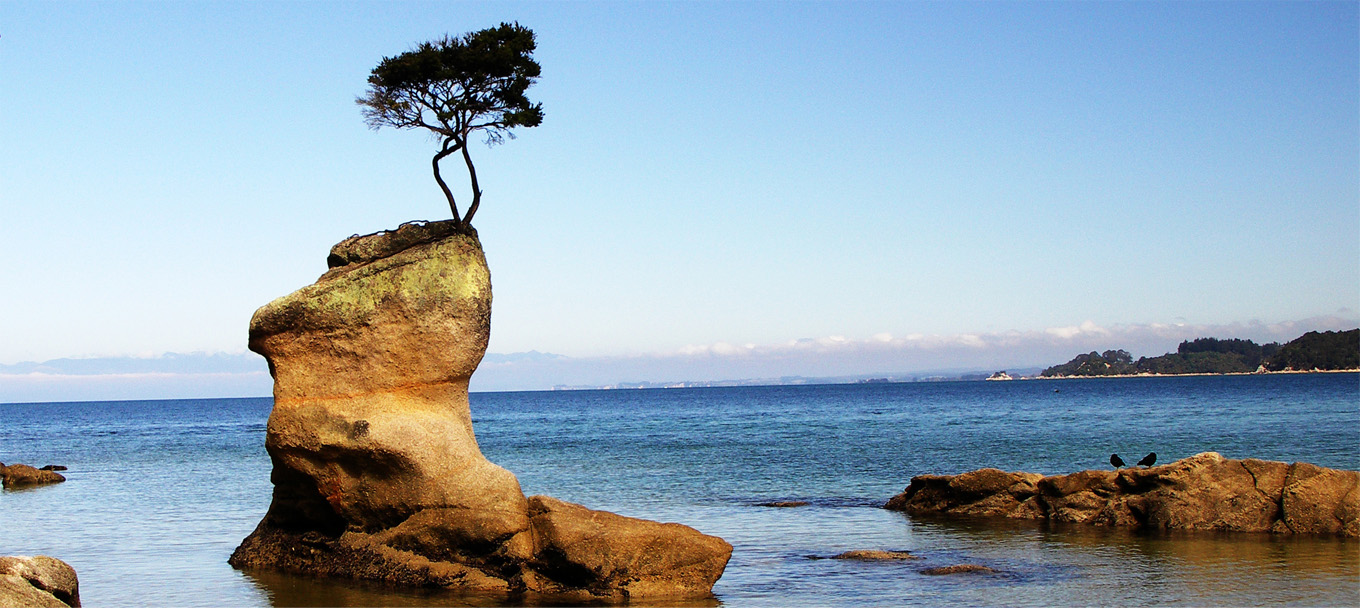
The young tree is placed in the middle of the Groasis Waterboxx® of Growboxx® plant cocoon which is placed almost on top of - just below - the hard soil. The small daily quantity of water apportioned to the tree, moisturizes the soil under the reservoir without danger of evaporation. This water restores the natural capillarity of the soil. In these 'vertical water canals', the roots find their way without any problem - even through stones and rocks. Trees have been doing this for millions of years. As you can see on the image below, trees can grow on rocks!
Start planting trees by yourself!
Everyone can start a project with the Groasis Ecological Water Saving Technology. Governments, ngo’s, small farmers or you if you have a garden. When you are starting a project, you can ask yourself the following questions:
- Is there a CO2 problem that we can solve?
- Do we have enough ground to plant one or multiple tree(s)?
- Can we find forestry zones without using fertile farmland?
- Can we use worthless, once forested semi-deserts?
- Can we plant trees on rocky surfaces and mountain slopes?
- Can we reforest disaster areas?
- Can we do this without expensive and non-available irrigation systems?
- Can we grow trees on location?
- Can we create an economic boost through forestry?
The answer to all these questions is: YES! The only thing we need is the willpower to really do it! Groasis Ecological Water Saving Technology makes it possible.
Go to our online shop to order all the products that you need to plant trees in a water saving, energy less and sustainable way.
When you grow and plant trees with the products of Groasis, you do not only save a lot of water, but you don’t need energy and it is cheaper than other planting methods!